
RESIDENT PORTAL
Redesigning how local government engages with the residents they serve
What do residents experience when accessing District services? What kind of information do native Washingtonians seek about city services versus new residents? What could have made that experience better? The dc.gov Redesign, a capital project assigned to the Office of the Chief Technology Officer (OCTO) by Mayor Bowser, aims to modernize the District’s official website by creating an easy-to-use portal where residents can access services seamlessly. While residents identified usability issues with dc.gov, they also shared a vision of a resident service portal that improves specific aspects of service delivery, such as customer service, increasing transparency on service requests, and reducing the need for residents to start a fresh application if their information hasn’t changed since they last certified for aid.
Table of Contents
01 Background
02 Challenge
03 Constraints
06 Demographics
07 Synthesis
Role (Individual Contributor): Design researcher, visual design, outreach and recruitment, coordinator, interviewer, interview synthesis and interpretation.
BACKGROUND
The complex online structure of DC government agencies is an access barrier for DC residents and an after-thought for agency staff who manage the content alongside their main responsibilities.
The Government of the District of Columbia consists of 75 agencies, each with its own dc.gov subdomain. Each agency may have an additional number of websites for its various departments and offices. Together, while dc.gov showcases the breadth of resources, opportunities, and city support available to DC residents, this fragmented structure has created confusion and frustration among residents when accessing this information online.
Organizational chart of the Government of the District of Columbia, which operates as a city, district, and quasi-state that also interfaces with federal government. Imagine that every entity on this organizational chart has their own website to manage their content and publishing of content. That’s how many websites there are.
CHALLENGE
How might we…
Collect meaningful feedback and ideas from residents on a digital experience that doesn’t exist?
The dc.gov Redesign, a capital project to modernize the District’s office website assigned to the Office of the Chief Technology Officer by Mayor Bowser, includes the “myDC” resident dashboard, which would be a new capability of dc.gov.
As the most resident-facing component of the DC.gov Redesign project, the Innovation Team was tasked to interview residents on how the new myDC resident dashboard could better serve their needs.
What dc.gov looks like on an off-day.
CONSTRAINTS
How might we…
Design an accessible interview medium to ensure
we are collecting perspectives from all eight Wards?
Requirements
Diverse Perspectives:
Must interview at least one resident from each of the eight wards;
Must interview at least one resident from each of the major genders represented in DC: Male, Female, Non-Binary;
Must interview at least one resident with a disability.
Bridge Language Barriers: Must interview at least one resident from each of the major ethnicities in DC: White, Black, Latino, Asian, and interview method must bridge language barriers.
Bridge Digital Literacy Gaps: Must interview at least one resident from each of the major age groups: 18–24, 25–34, 35–44, 45–54, 55–64, 65+.
Methodology Proportionate to One’s Time: In exchange for their time, we provided $25 gift cards to interviewees, therefore, interview methodology must not be longer than an hour.
Divide and Conquer: Must be easy to replicate so that we can have multiple interviews simultaneously in different parts of the District.
Public Setting: Must be able to meet resident at a public library or virtually on Microsoft Teams.
Transcription Limitations: No AI technology must be used to transcribe meeting notes.
No Precedence: There is no existing Resident Portal for residents to provide feedback on.
VISUAL COMMUNICATION
Simple Black & White Illustrations on Large Cards
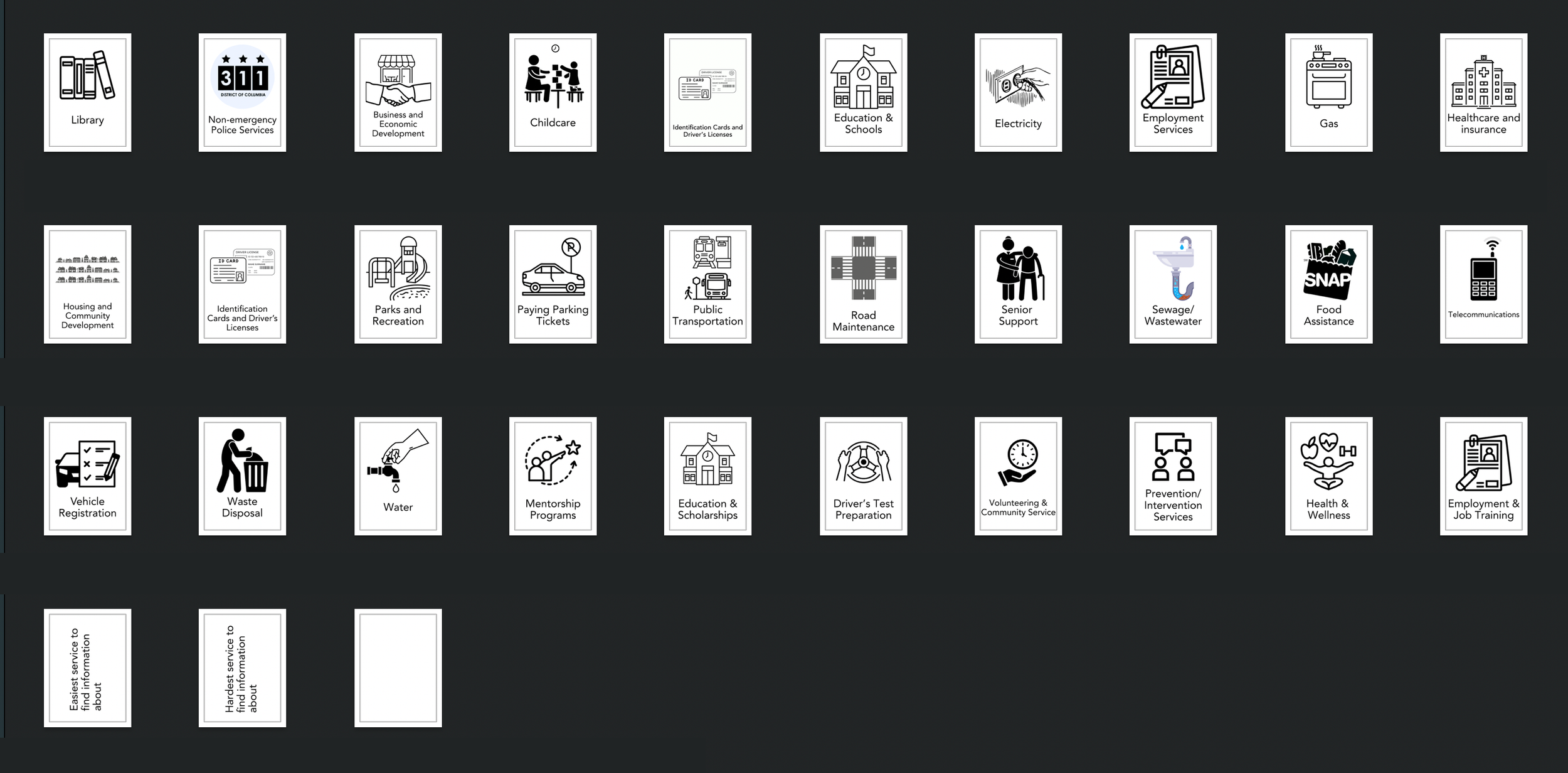
I designed a series of cards on Canva, using simple black and white illustrations to represent each service and communication method, each accompanied by an identifier/label in big, bold, black letters.
Part 1 of the activity inquires about the resident’s familiarity with various city services and which one(s) they most recently had experience navigating.
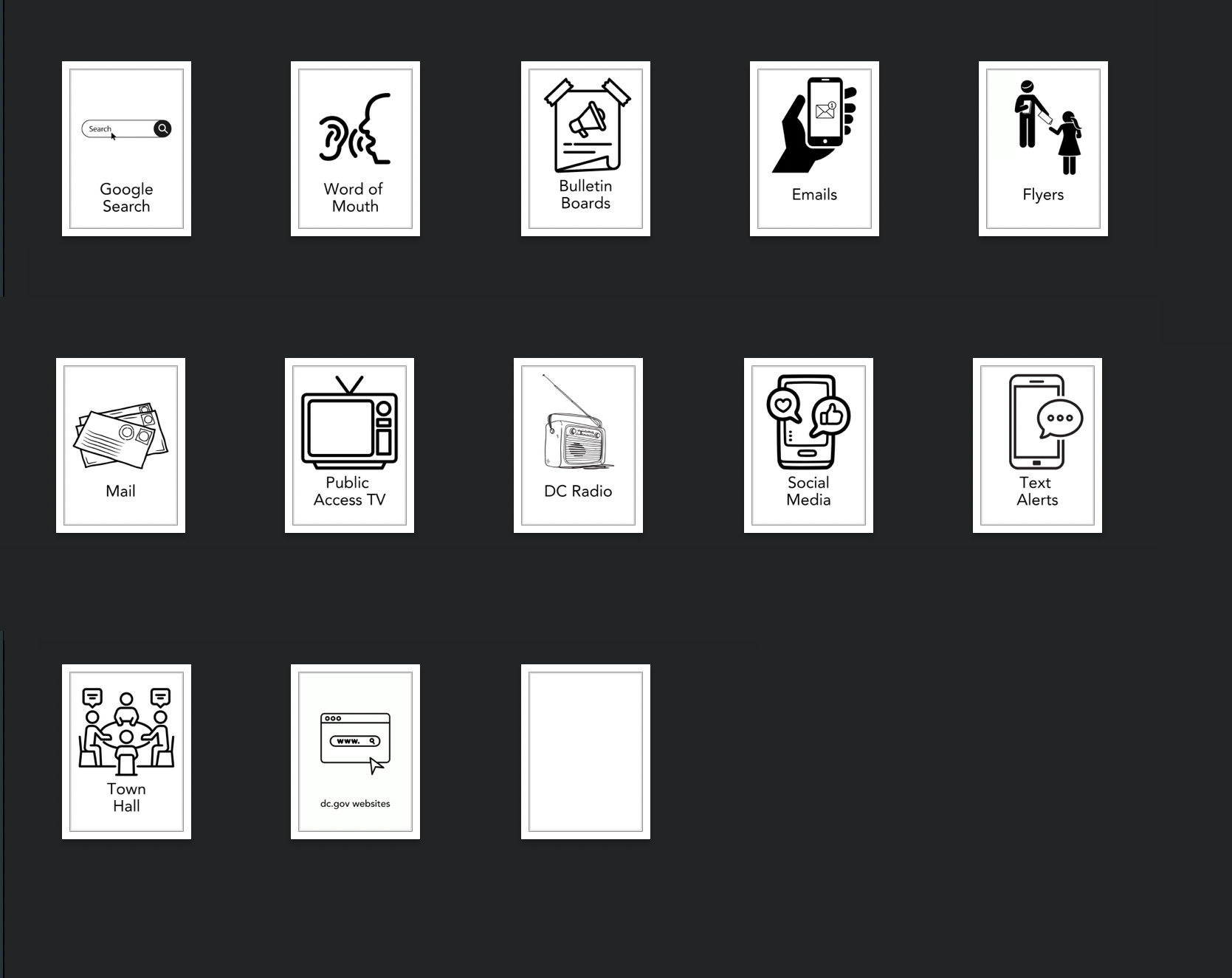
Part 2 of the activity inquires about the resident’s preferred modes of communication with DC government versus. Then, the resident is asked to elaborate why they prefer one communication method over the others.
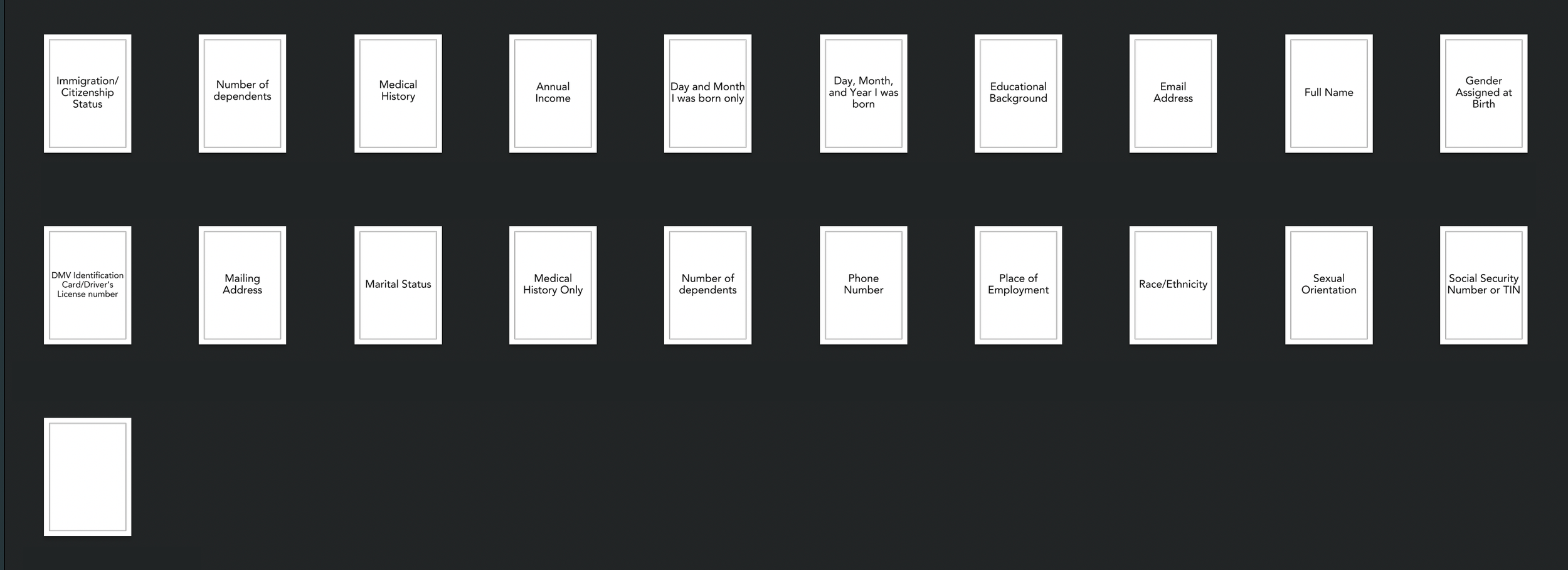
Part 3 of the activity inquires about the resident’s level of comfort regarding sharing different types of PII in order to apply for city services. Then, the resident is asked to elaborate which types of PII they believe are irrelevant for DC government to know.
USER INTERVIEWS
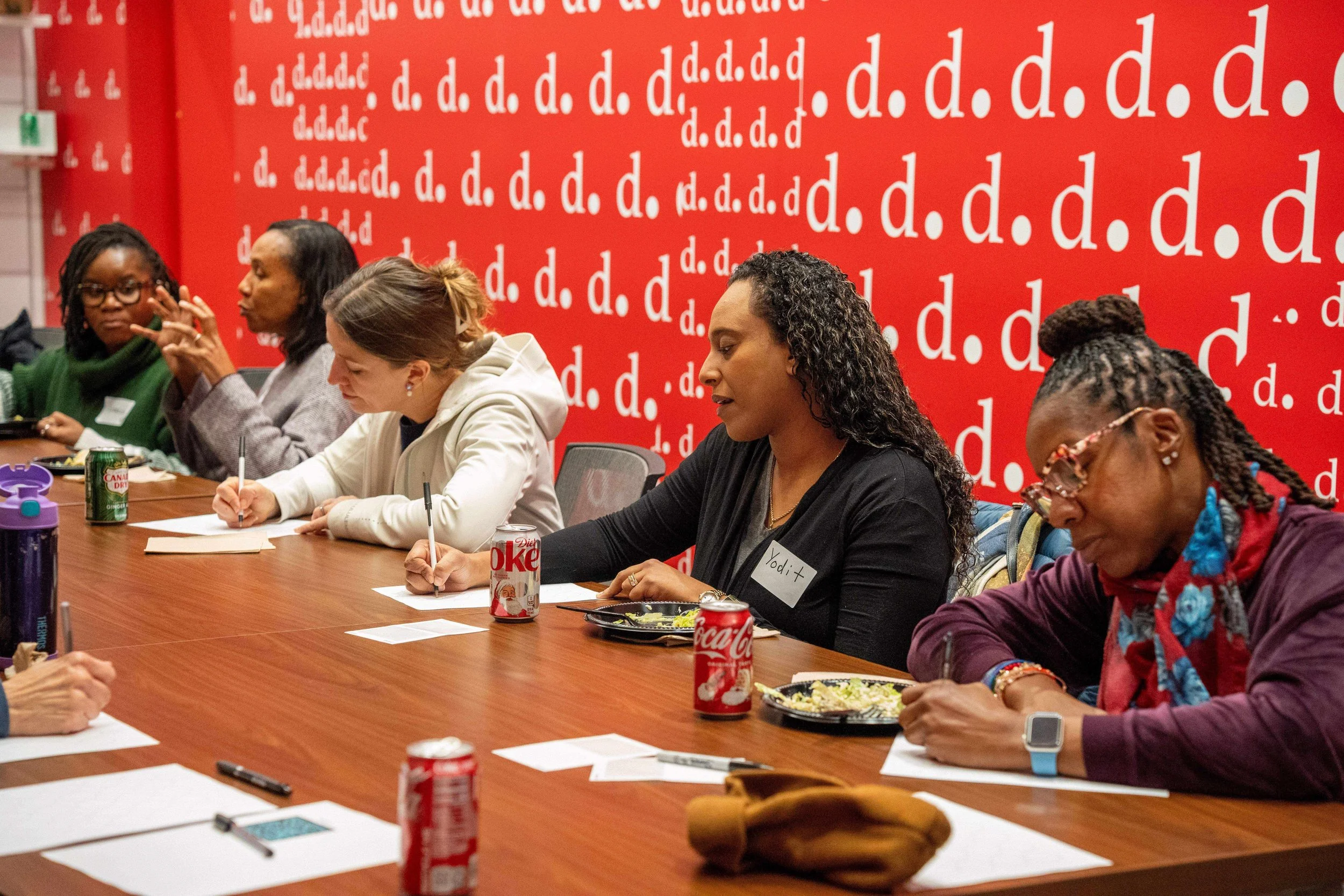
The prompts mirrored the affordances of the cards, encouraging the resident is physically manipulate the cards.
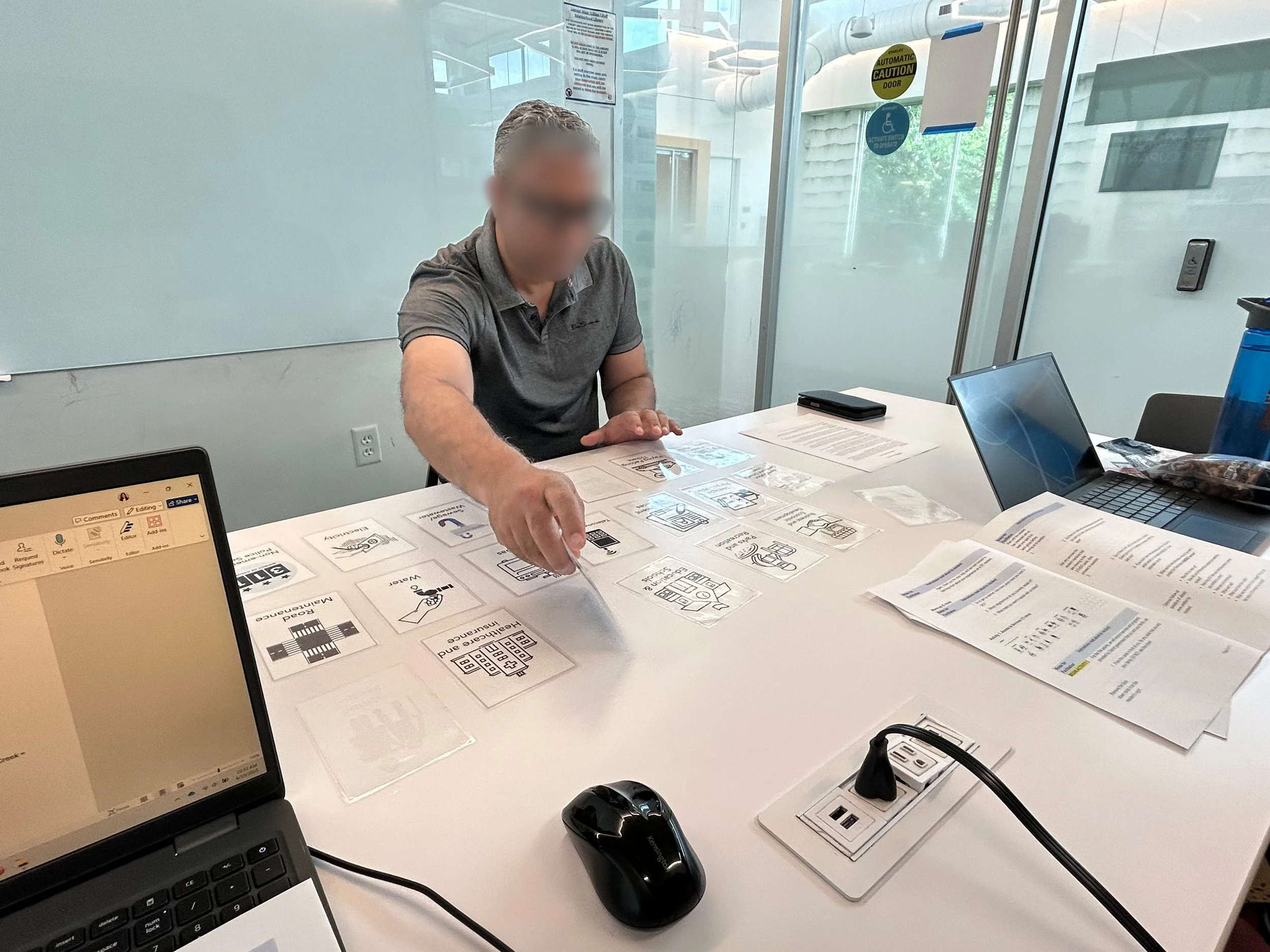
Resident flipping over cards that represent services they do not use.
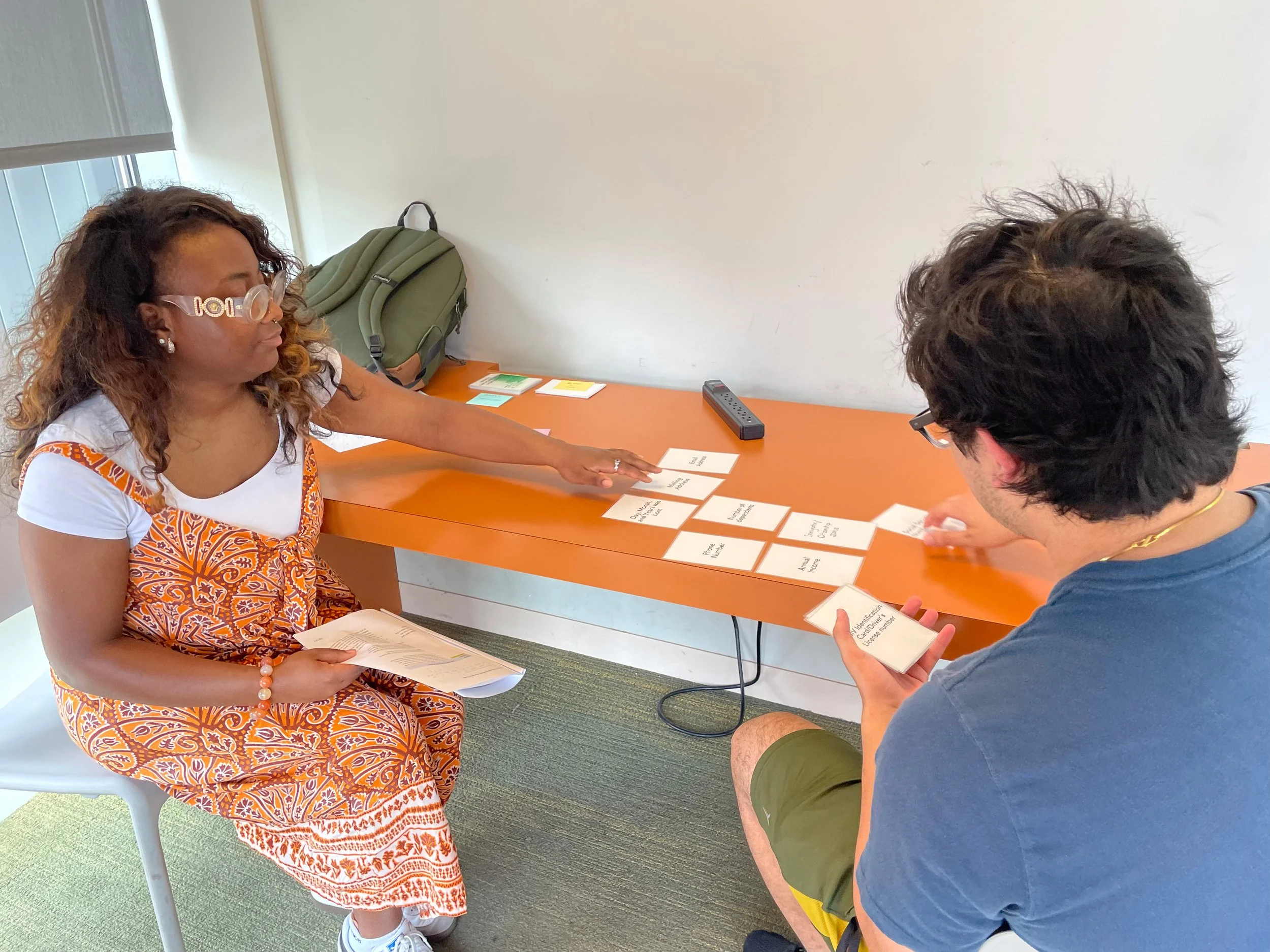
Another resident gathering which cards represent the types of personal information they’re more comfortable sharing with DC government services. Left, Eden Barclift, SYEP Intern leading interview with a peer.
Another resident comparing two services.
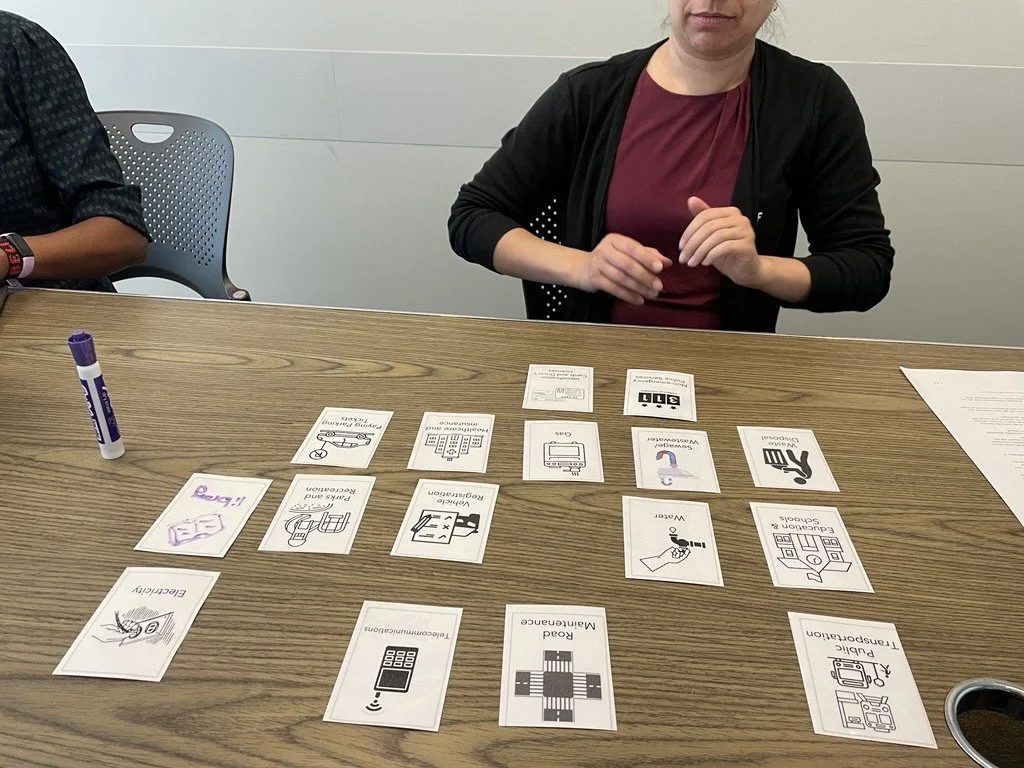
Another resident added a city service of their own.
DEMOGRAPHICS
With the cards, each interview was more interactive as each resident has something immediate to react to, rather than providing hypotheticals.
Because of the simplicity of the cards, we were able to bridge language barriers with residents of varying digital literacy levels, English proficiency, and age, while learning how their socioeconomic background impact which DC government services they depend on.
Number of Interviews Held: 16 (14 in-person, 2 virtual)
Residency: We met with at least one resident per Ward. We met with 4 residents from Ward 6 and 3 residents from Ward 3 and 7 respectively.
9 of our 16 residents have lived in DC for more than 10 years, while 3 of our 16 residents have lived in DC for the past 1 to 3 years at the time of interview.
Age: 13 of our interviewees are 25 years or older, with 5 of them aged 35 to 44 years old. 3 of our interviewees were 65 and older.
Race/Ethnicity: We met with at least one resident from one of the following racial/ethnic groups:
African American/Black
Hispanic/Latino
White/Caucasian
Asian
6 of our 16 interviewees identify themselves as White/Caucasian, while 4 identify themselves as multi-racial.
Gender: We met with at least one resident of each of the following genders:
Female (10 of our 16 residents identify as female)
Male
Non-Binary
Disability: 3 of our 16 residents identify themselves as someone with a disability.
Veteran/Military Status: 1 of our 16 residents identify themselves as a veteran or active duty member of the US Armed Forces, while 1 is a family member of a veteran or active duty personnel.
Caregiver Status: At least 6 of our 16 residents are either a parent or a caregiver.
Income: At least 3 of our 16 residents are low-income or on Medicare.
Language Barriers: None of our 16 residents identified themselves as learning English as a second language. However, 1 resident shared they help their parents bridge language barriers when interacting with DC services.
SYNTHESIS
There is correlation between services that are the hardest to find information on to the number of agencies involved in that process. Residents may not know who the correct personnel is, so they contact one entity and hope they are rerouted in the right direction. The most frustrating call trees involved the resident being redirected multiple times because staff at each touchpoint didn’t know the answer either.
At most, this results in residents unable to locate the correct information when they need it. At worst, this leads to programs becoming underutilized and the eventual elimination of services, hurting the city and abandoning the residents the program was meant to serve.
Communication Barriers
Difficult to find accurate information in a timely fashion
Reconciling incomplete or inaccurate information
Social interaction
No inherent value to one’s immediate needs
Inconvenient
Clutter
Refusal or inability to engage = unreliable source of communication
Customer Service Gaps
Redundant steps, leading to resistance to cooperate in the future
Interaction left resident feeling forgotten, neglected, disrespected
Lack of motivation to follow-through or engage because of previous negative initial interactions
Interaction left residents feeling like something better can be done that is currently not being done
Complex processes are especially challenging for residents experiencing them for the first time
What quality communication feels like?
Familiar
Not-time bound, reliable source of information
Good-to-know information by happenstance
Personalization
Sense of community and belonging
Autonomy enabled by ease of access
What quality customer service feels like?
Efficient
Only being asked the most basic, essential information, without being invasive
Reliable, consistent service
Timely, responsive, knowledge resolution to inquiries
Proactive, long-term solutions
Visible, active community engagement
Centralization of personal information for similar services
Achievable autonomy because of accessibility
-
There are many services provided to DC residents that it is likely we missed some, especially since the scope of services in which we would “modernize” on myDC was undefined.
As a result, the cards only surfaced the most basic, common services that the average resident would come in contact with. Additionally, due to the structure of DC government, there are some entities that residents commonly think is DC government, but are actually under their own authority, like DC Public Library.
Due to the generality of the services, some services were open to interpretation, which may have skewed the data. For example, one card a resident flipped over to signify they don’t use it was labeled “Healthcare” because they are on Medicaid. However, they would have needed to apply for benefits through the DC Health Link or District Direct.
Some of the other services we failed to include in our interviews were the DC Revenue Office (which was most relevant to homeowners), police and FEMS, Department of Buildings (again, only relevant to homeowners or small business owners), and DDOT (different from public transportation but more relevant to roadway drivers).
Regarding accessibility, I know better now than to design an engagement tool without provisioning or coordination from the Office of Disability Rights or the Language Access Coordinators. I would have like to have conducted these interviews in different languages other than English and use cards that had Braille on them as well.
If you liked this project, check out

Social media campaigns, publication design, and marketing materials for a 18-month project.

Infographic generation, publication design, and social media graphics for insights 10 years in the making.

Using human-centered design to understand COVID-19 vaccine hesitancy among Baltimore City residents.